Written by Arrive in Bloom (이름꽃), a Korean florist. Last reviewed 5 October 2026.
The short answer. A Korean funeral wreath has no card. The message goes on a vertical ribbon with two lines: one carries the condolence wording — most often 謹弔, “respectful condolence” — and the other carries the name of the sender, a person or an organisation. You pick the wording from a short standard list, add your name, and a Korean florist prints it.
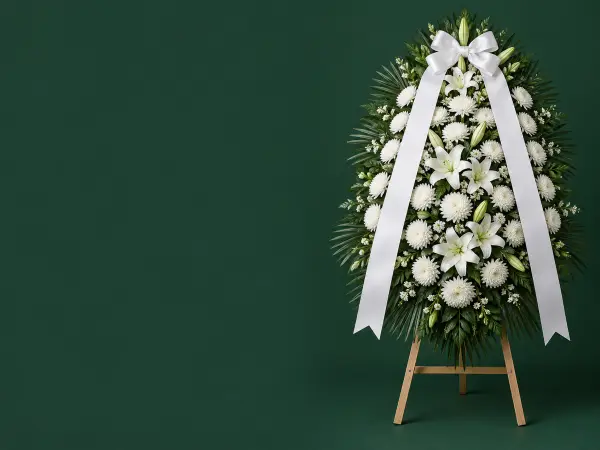
Ten ribbon wordings, and when to use each
These are the standard condolence wordings we offer on the ribbon, exactly as they are printed. The Hanja are the traditional Chinese characters Koreans still use on funeral ribbons; Hangul-only versions of the same words mean the same thing. When in doubt, the first one is never wrong.
| Korean / Hanja | Romanization | Meaning | When to use |
|---|---|---|---|
| 謹弔 | geunjo | Respectful condolence | The standard. Fits any relationship and is the safe choice when you do not know the family’s faith. |
| 삼가 故人의 冥福을 빕니다 | samga go-in-ui myeongbok-eul bimnida | “I respectfully pray for the peace of the departed.” | The sentence Koreans say aloud at the hall. Natural for colleagues, clients and friends. 冥福 is Buddhist in origin. |
| 삼가 弔意를 표합니다 | samga joui-reul pyohamnida | “We respectfully offer our condolences.” | A formal sentence without 冥福 — neutral, and well suited to a company or a group. |
| 追慕 | chumo | In remembrance | Looks back at the person rather than at the loss. Fits someone you knew well and memorial occasions. |
| 追悼 | chudo | In mourning | More formal than 追慕; the word used for memorial services (추도식). |
| 哀悼 | aedo | With deep sorrow | Sorrow shared with the family — plain and heartfelt, good for a close friend. |
| 賻儀 | buui | Condolence offering | The word written on condolence-money envelopes. It can go on a ribbon, but 謹弔 is the usual wording for a wreath. |
| 부디 편안히 永眠하소서 | budi pyeonanhi yeongmyeon-hasoseo | “May you rest in eternal peace.” | Speaks to the person who died. Warm — best for someone close to you rather than formal business. |
| 슬픔을 함께 나눕니다 | seulpeum-eul hamkke nanumnida | “We share your grief.” | Speaks to the family in plain Korean. Good when you know them personally. |
| 고인의 뜻을 오래 기억하겠습니다 | go-in-ui tteut-eul orae gieokhagetseumnida | “We will long remember the wishes of the departed.” | Honours what the person stood for. Fits colleagues, teachers and community figures. |
On the order form you can choose a wording by its English meaning and the Korean is filled in for you. You can also type your own Korean or English wording.
The sender line: how to write your name
The second line says who sent the wreath. Everyone at the hall reads it, including relatives who will later check who came, so do not leave it out.
| Who is sending | Format | Example | Reads as |
|---|---|---|---|
| Yourself | Your name | John Smith | English is fine. Add your company or your relationship if the family may not recognise the name. |
| Yourself, from a company | Company + title + name | ABC 코리아 대표 John Smith | “ABC Korea, CEO John Smith.” The format used on the funeral etiquette page. |
| A company or a team | ○○ 일동 | ABC 코리아 임직원 일동 | 일동 means “all of us”: all executives and staff of ABC Korea. 영업팀 일동 would be “the whole sales team”. |
| Friends or classmates | 친구 일동 / ○○ 동기 일동 | 친구 일동 | “All your friends” or “everyone from the same year at ○○”. |
Sending from abroad
The ribbon is printed by a Korean florist, and Korean and English text can both be printed. Your own name, or your company’s name, can go on in English exactly as you give it. Japanese and Chinese text cannot be printed; the standard Hanja words in the table above are chosen from the list. Keep each line short: about 20 characters or fewer reads best on a wreath, and the order form accepts up to 40 per line.
If the family has a faith
The wordings above work for most families. These notes only help you choose between them, and agree with the funeral etiquette guide.
| Tradition | What to know |
|---|---|
| Protestant Christian | The notice may say 소천 (召天, “called to heaven”). Some devout families prefer not to receive 冥福, which is Buddhist in origin. 追慕, 弔意, 哀悼 and 슬픔을 함께 나눕니다 are the neutral choices. |
| Catholic | The notice may say 선종 (善終, “a good death”). 謹弔 and the neutral wordings above work well. |
| Buddhist | 삼가 故人의 冥福을 빕니다 is at home here, since 冥福 is a Buddhist word. |
| Unknown or none | 謹弔 is the usual safe choice. |
What not to write
- Celebration words — 祝 (“congratulations”), 축하, “Happy…”, “Best wishes”. Congratulatory wreaths look similar and carry 祝 ribbons, so order from the funeral category.
- Red or bright colours — keep it white; the etiquette guide also lists red among the things to avoid.
- The cause of death, jokes, or a long personal message. A ribbon is public; keep that for a card or for the family in person.
- An empty sender line. The name on the ribbon is how your absence is recorded.
Six short card messages in English
A wreath carries its ribbon and no card. If you send a basket or a bouquet instead — for example to the family’s home after the three days — it carries a hand-written card. These are short enough to copy as they are.
To a friend who lost a parent
To a colleague
After a grandparent’s death
From a company
When the loss is sudden
When you cannot be there
Send a wreath with this wording
The standard three-tier funeral wreath is $54 (₩59,000) delivered to any funeral hall in Korea. An urgent wreath reaches the hall in about 3 hours, and the same-day cut-off is 5 PM KST. You pay in USD through PayPal, by card, without a PayPal account. See the 3-tier funeral wreath.
Also free: an English mobile obituary notice if you are the one announcing a death, and a thank-you note for the family to send afterwards.
Frequently asked questions
- What do you write on Korean funeral flowers?
- There is no card on a Korean funeral wreath. The message goes on a vertical ribbon with two lines: one carries the condolence wording, most often 謹弔 (“respectful condolence”), and the other carries the sender’s name or organisation. The ribbon is read by everyone who walks past the wreath at the funeral hall.
- What does 謹弔 mean on a funeral wreath?
- 謹弔 (geunjo, 근조) means “respectful condolence”. It is the standard wording on standing wreaths and suits any relationship, which makes it the safe choice when you do not know the family’s religion.
- Can I write the ribbon in English?
- Yes. The ribbon is printed by a Korean florist and both Korean and English text can be printed; Japanese and Chinese cannot. Your name or company can be written in English exactly as you give it. For the condolence line you can pick a standard wording from the list, which prints in Korean or Hanja, or type your own English wording.
- How do I sign a funeral wreath from a company or a group?
- Write the organisation followed by 일동 (ildong, “all of us”), for example ABC 코리아 임직원 일동 for all executives and staff of ABC Korea. To sign for yourself as a representative, write the company, the title and your name, for example ABC 코리아 대표 John Smith.
- Does a Korean funeral wreath come with a card?
- No, the ribbon is the message. If you send a basket or a bouquet instead, for example to the family’s home after the funeral, that carries a hand-written card, and the short English examples on this page are written for that.
- What should I avoid writing on funeral flowers?
- Avoid celebration words such as 祝 (“congratulations”), 축하 or “Happy”, avoid red and other bright colours, and keep the wording short without the cause of death or personal jokes. Order from the funeral wreath category, because congratulatory wreaths look similar but carry 祝 ribbons.
Send the wreath, with the right words on it
Delivered to the funeral hall, and we send you a photo of it standing there with the ribbon readable.
Send a funeral wreath — $54 How it works from abroad