FLOWER STORIESPlants & Orchids
Can an Office Orchid Get By Without Much Light?
A congratulatory orchid under fluorescent lights lasts longer once you settle where it sits and who looks after it
A congratulatory orchid under fluorescent lights lasts longer once you settle where it sits and who looks after it
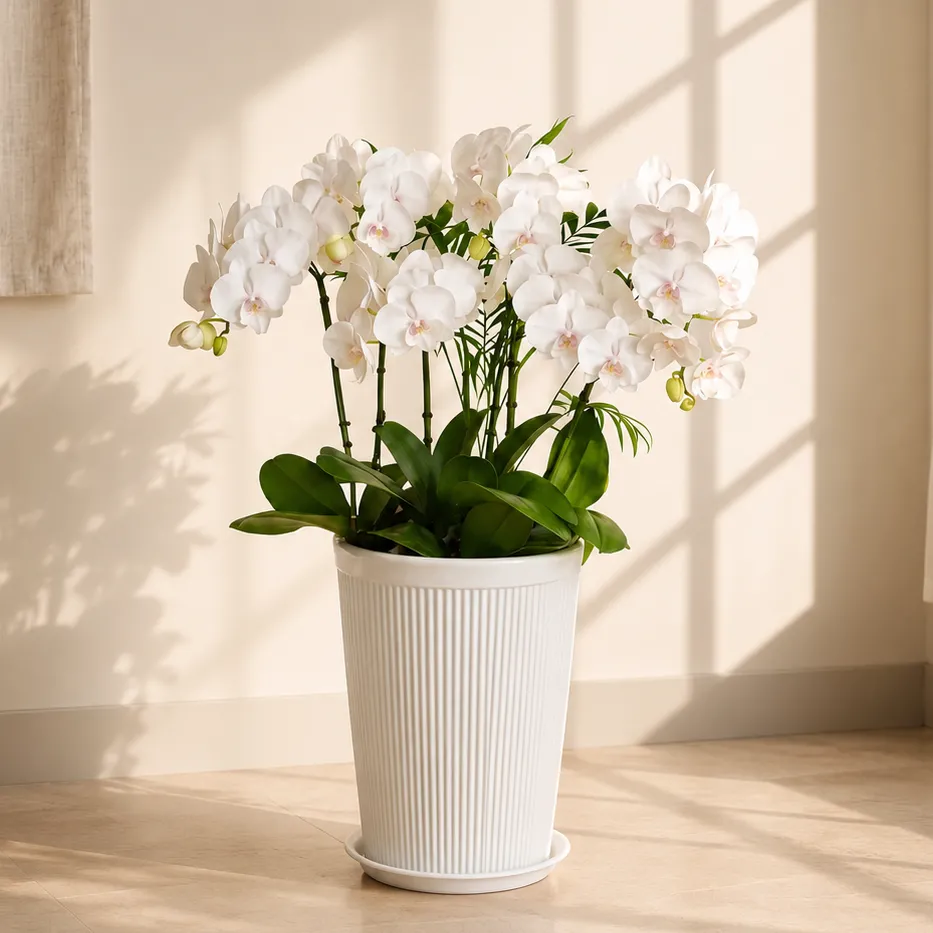
It has been a month since the congratulatory orchid, or 축하 난 (an orchid sent to mark a promotion, new office or opening), arrived. If it has been sitting under fluorescent lights and the leaves are drooping and the buds are yellowing and dropping, there is something to check before you blame the light. Office orchids rarely die from low light alone. They weaken when light, airflow and water are each a little off.
Everyone knows the rule: keep it somewhere bright and water it when it dries out. This post looks at why that rule tends to break down in an office, and how to fix it by deciding on the right spot and the right person.
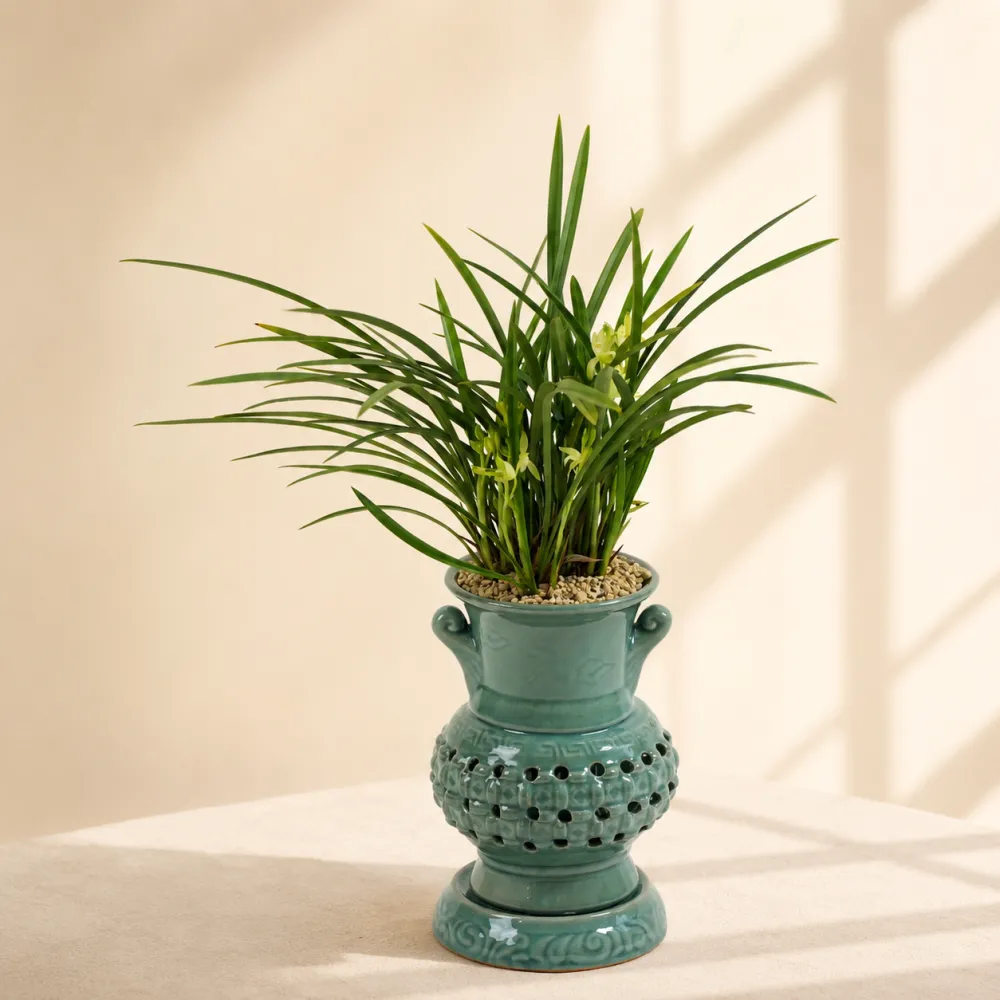
It can survive, at least for a while. Moth orchids (호접란, Phalaenopsis) and 동양란 (Asian cymbidiums, the slender-leaved orchids traditionally grown in Korea) naturally grow in forest shade and don't need strong sunlight. That is why they can look fine under fluorescent lights for a few weeks.
The problem is how far away the lights are and how long they stay on. Ceiling lights are a long way from an orchid on a desk, and they go off after work and over the weekend. The room may look bright to you, but the orchid gets far less light than it would by a window.
So an orchid with only fluorescent light may keep the flowers it already has, but it can't build up the energy for new leaves or its next flower spike. New leaves that grow thin, long and floppy are a sign it isn't getting enough light.
If you can't move the orchid to a window for good, move it to the window before you leave on Friday and bring it back on Monday. The weekend, when nobody is in the office, becomes its time to take in light.
A safe spot is a little back from the window, where the light first passes through blinds or a thin curtain. If the leaves don't feel hot to the touch and the plant casts only a soft, blurry shadow, that is enough.
In summer, an orchid pressed right up against a south- or west-facing window can get white scorch marks or dark burns on its leaves. Even sunlight through glass is too strong for an orchid at midday.
Air from air conditioners and heaters causes problems faster than low light does. When air from a vent blows straight onto the plant, the leaf tips dry out and the buds drop before they open. If you can feel a draft on your palm where the orchid sits, move it.
Offices switch off heating and cooling at night and on weekends, so the temperature swings a lot between day and night. In winter the window area gets cold overnight, so move the orchid a step back from the window when you leave for the day.
| Location | Moth orchid | Asian cymbidium | What to do |
|---|---|---|---|
| Inner desk with only fluorescent light | Keeps its flowers, but a new spike is unlikely | New leaves grow thin and floppy | Move it to the window on weekends |
| By a window, behind blinds | Suitable | Suitable | Make this its regular spot |
| Right against a south- or west-facing window | Watch for scorched leaves | Watch for burnt leaf tips | Move it back a step or draw the curtain |
| Near an air conditioner or heater vent | Buds drop | Leaf tips dry out | Move it out of the airflow |
A common reason office orchids fail is that several people each water it once because it "looked dry." Each person waters it only once, but the orchid ends up being watered several times in a few days.
After watering, always empty the saucer. Roots left sitting in water can't breathe, and they rot. The leaves then wilt, which looks like the plant needs water, so someone waters it again. Also lift the plastic wrapping or look inside the outer pot to check whether water has collected there.
So pick one person to do the watering. Keep a small card next to the pot and write down the date and the name of whoever watered it, so everyone else can check the card and leave the plant alone. When that person goes on holiday, write the name of whoever is covering on the card.
When a moth orchid finishes flowering, cut the spike leaving two or three nodes from the bottom. A new spike sometimes grows from one of those nodes. For an Asian cymbidium, cut the flower stalk off at the base so the plant can put its energy into its leaves and new shoots. Keep it in its window spot while it isn't in flower.
If you need to send an orchid that will stay in an office for a long time, you can find options at Arrive in Bloom.
It will get by for a while, but with so little light it has trouble producing new leaves and its next flower spike. Moving it to a window, even just over the weekend, gives it some light.
If the bottom of the pot sits in water, the roots can't breathe and may rot. After watering, empty any water left in the saucer and inside the wrapping.
Cut it leaving two or three nodes from the bottom. A new spike sometimes grows from one of those nodes. For an Asian cymbidium, cut the flower stalk off at the base.
Pick one person to water it, and keep a card next to the pot with the date and name each time it's watered. That stops several people from watering it one after another.
Arrive in Bloom sends orchids through more than 500 partner ateliers across Korea. Once your order is delivered, we send you an unedited photo of the arrangement. Orders placed before 5 p.m. (Korea time) are delivered the same day.
Published September 25, 2026 · by Arrive in Bloom · Flower Editor