FLOWER STORIESPlants & Orchids
What a Plant Actually Does for a Room
An honest look at the air-purifying claim, and the better reason to send one
An honest look at the air-purifying claim, and the better reason to send one

Search for almost any indoor plant and within two clicks you will meet the claim: purifies the air, removes toxins, NASA-approved.
We sell plants. It would be easy and profitable to repeat it. But the claim does not survive contact with the arithmetic, and we would rather tell you what a plant genuinely does — which is, as it happens, a better reason to send one.
In the late 1980s NASA ran a study on whether plants could scrub volatile organic compounds from air, with an eye to sealed spacecraft environments. Plants were placed in small sealed chambers, the air was dosed with a compound, and the concentration was measured as it fell.
The results were real. In a sealed chamber the size of a box, a plant measurably reduced certain compounds.
The problem is the leap from that chamber to a living room. Later analyses that scaled the numbers up to ordinary rooms with ordinary air exchange found that you would need an implausible number of plants — on the order of many per square metre — to compete with simply opening a window. A house has leaks, doors, ventilation. Air is being replaced constantly, far faster than a few leaves can process it.
The study was not wrong. It was answering a question about spacecraft, and got repeated as though it were about apartments.
Something less dramatic, better evidenced, and more relevant to the person you are sending it to: it changes how the room feels to be in.
There is a substantial research literature on indoor greenery and human attention — on the way natural elements in a workspace are associated with reduced reported stress and improved recovery from concentrated effort. The effect sizes are modest and the field has its arguments, as all such fields do. But the direction is consistent, and it matches what people report without being asked.
Nobody has ever walked into a room with a large plant in it and said the air feels cleaner. A great many people have walked in and felt the room was more pleasant to sit in. That second thing is real, and it is what you are buying.
There is also something a study cannot capture.
A plant is the only object in most rooms that requires anything of the person in it. A picture asks nothing. A lamp asks nothing. A plant needs to be looked at with some attention roughly once a week — is the soil dry, are the tips browning, has it started leaning toward the window.
For someone living alone, or working long hours, or newly arrived in a city where they know nobody, that small recurring obligation is not a burden. It is a structure. It is one thing in the room that notices whether you are there.
That is not a claim we can footnote. But it is the reason people keep them.
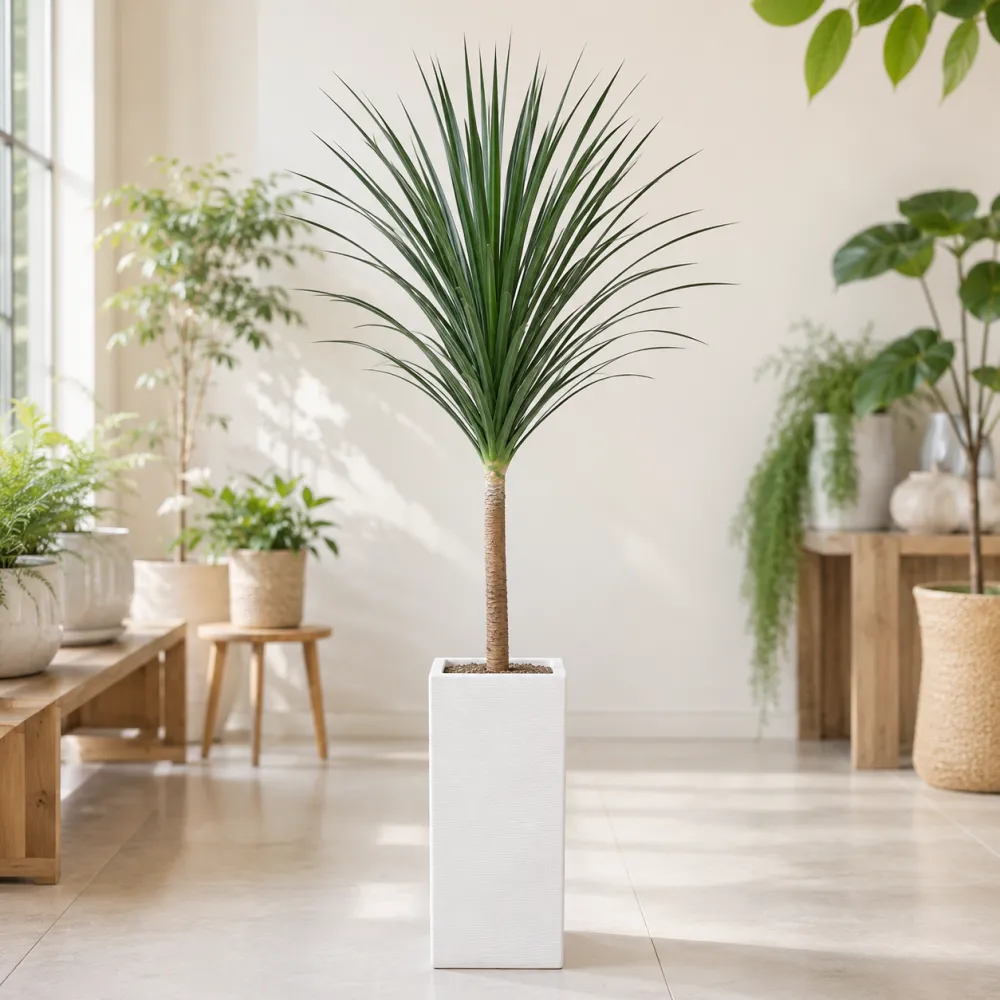
Bright indirect light; tolerant of less. Water only when the top several centimetres of soil are dry — this genus is far more often killed by overwatering than by drought. Brown papery leaf tips usually indicate minerals in tap water or dry winter air rather than thirst; filtered water and an occasional deep flush of the pot help.
Wipe the leaves occasionally. Dust genuinely does reduce the light reaching the leaf, and it is the one piece of plant maintenance almost everybody skips.
Toxic to cats and dogs if chewed.
Do not buy this to clean anyone's air. Open a window for that.
Buy it because a room with a large living thing in it is a better room to spend a life in, and because the person you are sending it to spends more hours in that room than in any other — and you are not going to be in it with them.
Not meaningfully at household scale. The often-cited NASA research was conducted in small sealed chambers; when the figures are scaled to a normal room with normal ventilation, you would need an impractical density of plants to match simply opening a window. The measurable benefits of indoor greenery are psychological rather than chemical — and they are well worth having.
It is one of the most commonly used office plants in Korea, because it tolerates moderate light and irregular attention. It is also the standard Korean gift for a business opening or an office move, and will be read that way by the recipient.
Bright indirect light is ideal and keeps growth compact. It will survive in moderate light, but growth slows and new leaves come in less strongly. Avoid direct afternoon sun, which scorches the leaf edges.
A floor plant delivered and set in place by hand anywhere in Korea, with a handwritten card or ribbon in English or Korean at no charge. Order in USD from anywhere, and we will send you a photograph of it in the room where it now lives.
Published September 6, 2026 · by Arrive in Bloom · Flower Editor