FLOWER STORIESPlants & Orchids
The Tree That Was Named After a Dragon
Dracaena means 'she-dragon' in Greek. There is a reason, and it is red.
Dracaena means 'she-dragon' in Greek. There is a reason, and it is red.

Most botanical names are administrative. Officinalis means it was sold in shops. Vulgaris means it was common. Latin binomials are, as a rule, the least romantic writing humans produce.
Then there is Dracaena, from the Greek drakaina: she-dragon.
Cut or wound certain species in this genus and the sap that emerges oxidises to a deep red. The best known case is the dragon tree of the Canary Islands, whose resin was traded across the ancient and medieval world under the name dragon's blood — used as a dye, a varnish, and, inevitably, a medicine for things it could not cure.
Whether anyone truly believed it was dragon's blood is beside the point. What is documented is that people paid for it, carried it a long way, and named the tree after the story rather than the plant.
Before it was a houseplant it was a rumour with roots.
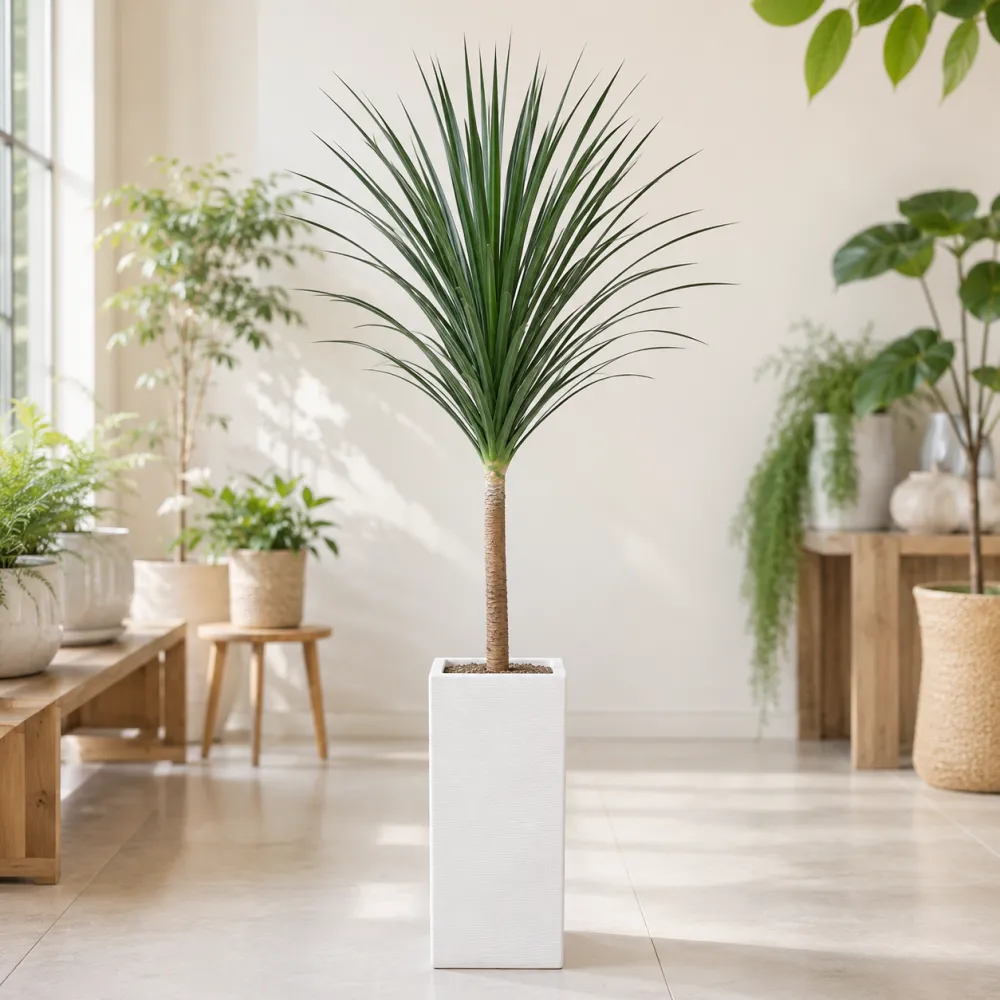
Set the mythology aside and what you have is a plant with an unusual silhouette: a bare woody trunk, sometimes branching, topped with dense rosettes of narrow leaves. It reads as architecture rather than decoration.
This matters in the rooms these usually go into. A bushy plant fills a corner; a dragon tree marks one. In a shop entrance, a clinic waiting room, a new office — the places these are most often sent in Korea — that vertical, sculptural line does something a mass of foliage cannot. It gives the space a fixed point.
The Korean custom of sending plants for a business opening is practical as well as symbolic. Flowers at a shop opening last a week; the shop needs to look established for longer than that.
But there is a symbolic logic too, and the dragon tree fits it neatly. What you are wishing someone at an opening is not a good week. It is longevity. A slow, woody, decade-scale plant is a more coherent expression of that wish than anything cut.
If you are sending from overseas to mark someone's new venture, this is among the most legible gifts you can choose. Korean recipients will read it correctly without explanation.
Light. Bright indirect. Tolerates moderate light, which is why it survives in offices, but growth slows noticeably.
Water. Sparingly. Let the top several centimetres dry out completely. These store water in the trunk and resent sitting wet; root rot is the usual cause of death.
Leaf tips. Brown, papery tips generally indicate fluoride or salt build-up from tap water, or very dry air. Filtered water and an occasional flush of the pot solves most of it.
Lower leaves falling is normal and expected. The plant is building trunk. Do not treat it as illness.
Toxic to cats and dogs if chewed — worth checking before sending into a home with animals.
We live in a period of extremely fast gifts. Things arrive within hours of being thought of. Most of them are consumed and forgotten inside a season.
There is a particular pleasure in sending the opposite: an object whose entire nature is that it will not hurry, and which will still be standing in the same corner long after everyone has forgotten which year it arrived.
It belongs to the same genus, Dracaena, which takes its name — 'she-dragon' in Greek — from the red resin that certain species in the group produce when cut. Plants sold under this name in the Korean nursery trade are grown as ornamental indoor specimens rather than collected wild.
It is the standard gift. Walk past a newly opened shop or office in Korea and you will usually see plants inside the door with ribbons naming the senders. We can add a ribbon with your message in Korean or English at no charge — just tell us what it should say.
Less often than they will want to. Let the top several centimetres of soil dry out completely between waterings. Dracaenas are much more often killed by overwatering than by neglect, and this one stores water in its trunk.
A sculptural, decade-scale plant delivered and set in place by hand anywhere in Korea — the standard gift for an opening, a move, or a new beginning. Ribbon or handwritten card in English or Korean at no charge, ordered in USD from anywhere.
Published September 2, 2026 · by Arrive in Bloom · Flower Editor