FLOWER STORIESGuides
Wreath Etiquette and Ribbon Wording — How to Say Exactly What You Mean
A wreath is an object that stands in a place on a person's behalf.
A wreath is an object that stands in a place on a person's behalf.

A wreath is an object that stands in a place on a person's behalf. Some people are too far away; others are too tied down by their own lives. They cannot be there in person, and one wreath fills that empty space for them. Yet what a wreath conveys is not the quantity of its flowers but the single line written across it, and the moment at which it arrives. A sentiment becomes a sentiment only when it is precise.
This guide sets out the two branches of ceremonial wreaths and the difference in their colors, the convention for how ribbons are written and what to say in each situation, and the etiquette of timing. It is written from fact, so that even a first-time sender can convey their heart without a misstep.
Ceremonial wreaths fall into two broad branches. The first is the congratulatory wreath, which stands where something new begins: a shop opening or a clinic opening, a wedding, a promotion or inauguration, the opening night of a performance or exhibition. The second is the condolence (funeral) wreath, which sees off the one who has departed. It is placed at the mourning hall, standing quietly beside the grief of those left behind.
The two are easy to confuse because their forms are similar. The commonly used three-tier wreath rises on a stand with three layers of flowers stacked one above another, taller than a person. The shape is meant to be seen at a glance from a distance, which is why it is the first thing to greet guests at the entrance of an event hall or a mourning hall.
The clearest thing that separates congratulation from condolence is color. A congratulatory wreath uses bright hues such as yellow, pink, and red. It speaks the joy of a new beginning first, through color. A condolence wreath is restrained and calm, centered on white and yellow, because exuberant color does not belong at a place of grief.
For this reason, the first thing to make clear when you order is the purpose. Even in the same three-tier form, color determines the occasion. State accurately whether it is for celebration or for mourning, and the color composition will never go astray.

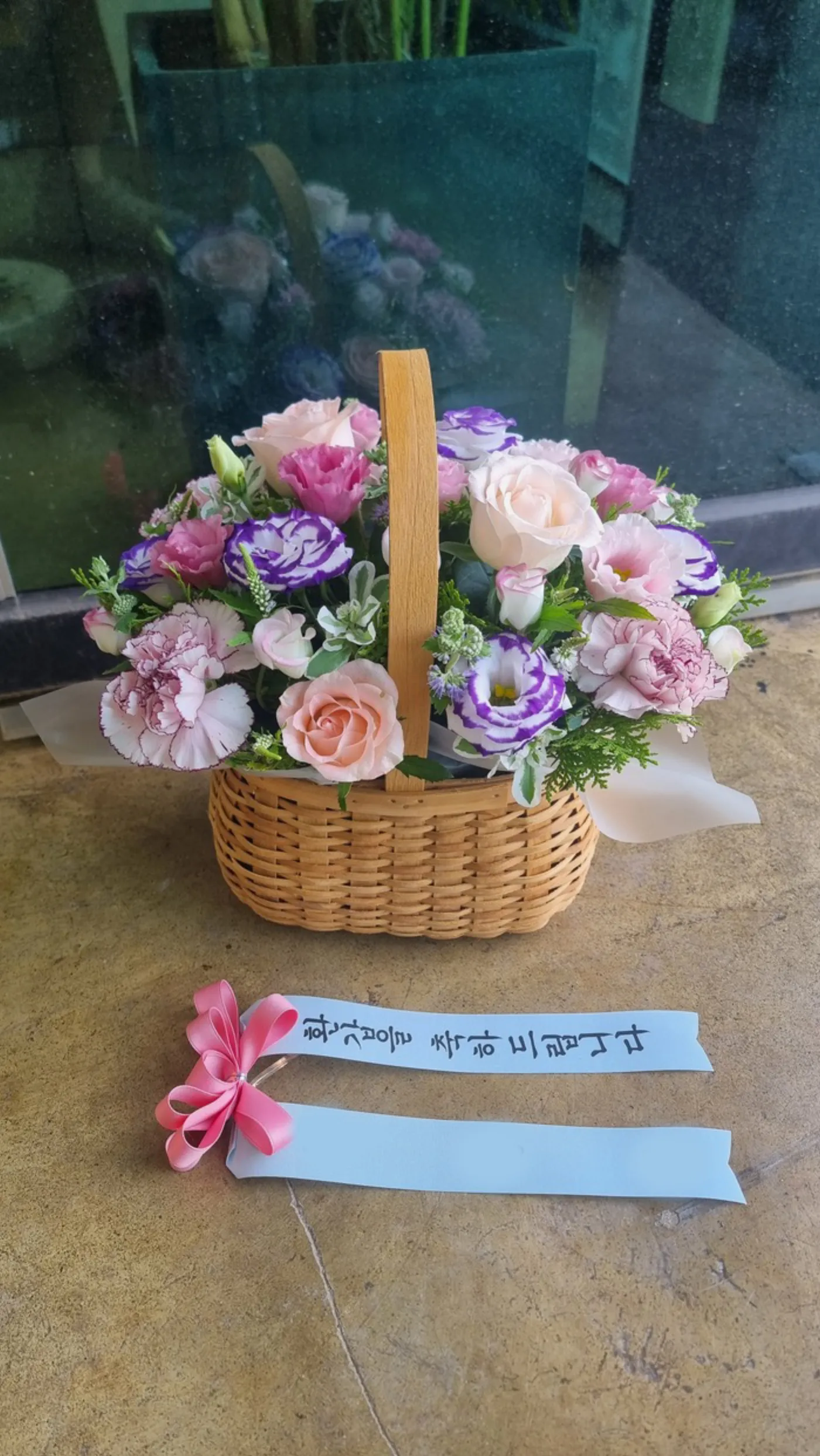
A wreath usually carries two ribbons. By convention, as you face the wreath, the left ribbon bears the name, affiliation, or title of the sender. The right ribbon bears the recipient's name together with a line of well-wishing. (In the Korean tradition, the right ribbon is the message to the recipient, and the left ribbon is the sender's name.) Simply keeping this left-and-right order lets the wreath state clearly who sent it and to whom.
The wording is best kept short. A brief, clear line lands more precisely than a long sentence. Above all, the recipient's title and name must be checked down to the last letter. Accuracy of the name comes before any flourish of phrasing.
A sentiment becomes a sentiment only when it is precise — settled by a single letter of a name and a single hour of arrival.
Korean wreath ribbons carry a short set phrase. The examples below show the Korean phrase with what it means, so an English reader can choose the right one:
For a wreath, when it arrives matters as much as what is written on it. Even the same sentiment, if its timing is off, lingers like an empty seat.
A congratulatory wreath should arrive before the event begins. For a shop opening, it should be standing at the entrance from the evening before through the morning of the day, before the guests arrive — only then is the scene of support complete. A wreath that arrives after the event has started becomes a greeting that missed the very moment of greatest joy.
A condolence wreath is different. The courteous thing is to send it after the mourning hall has been set up. If you rush to send it the instant you hear of a passing, the hall may not yet be ready and there will be no place to receive it; send it too late and it will not arrive before the funeral procession. The most respectful approach is to confirm that the mourning hall has been prepared, then send it in time for the visiting hours.
Whether for celebration or condolence, wreath etiquette finally comes down to a question of timing. A wreath that must arrive the evening before, and one that may only be sent after the mourning hall is set up, call for a different sense of the time it takes from order to delivery. For something as sudden as news of a passing, same-day delivery can be the only way to keep pace with the speed of the heart.
Arrive in Bloom takes orders 24 hours a day, and an order placed before each region's cutoff time arrives the same day. Working directly with the wholesale market, we prepare flowers brought in at the dawn auction and send them out that same day, and we publish the actual delivered arrangements — with no retouching or staging — exactly as they are in our gallery. The very sight the recipient will see is one the sender can confirm in advance. For urgent cases, call our main line at 1666-6584 to fine-tune the moment of arrival.
A wreath stands in a place on a person's behalf. Even when you cannot be there yourself, an accurate name, a single line of well-wishing, and flowers that arrive at the right hour stand your sentiment up to full height to greet the guests. At Arrive in Bloom (이름꽃.com / flowername.co.kr), we tend to both the letters and the hour so that your heart never goes astray.
As you face the wreath, the left ribbon bears the sender's name, company, or title, and the right ribbon bears the recipient along with the well-wishing phrase (for example, “Congratulations on your opening” or “Congratulations on your inauguration”). Most important of all is to confirm the recipient's title and name down to the last letter.
It is best to have it arrive before the event begins — from the evening before through the morning of the day. For an opening, where wreaths line the entrance on the first day, they must be standing before the guests arrive for the scene of support to feel complete. A wreath that arrives after the event has started misses the moment of greatest joy.
The most widely used phrase is “May the departed rest in peace.” The sender's name or affiliation goes on the left ribbon, and this message of mourning goes on the right ribbon. The courteous practice is to send the wreath after the mourning hall has been set up, in time for the visiting hours.
Even in the same three-tier form, they are told apart by color. Congratulatory wreaths use bright hues such as yellow, pink, and red, while condolence wreaths are restrained, centered on white and yellow. State the purpose (celebration or mourning) when ordering and the color composition will be set correctly.
Opening or inauguration, wedding or condolence — a wreath is completed by the right name and the right moment of arrival. We take orders 24 hours a day, and an order placed before your region's cutoff arrives the same day. We prepare dawn-auction flowers that very day and publish the actual delivery photos exactly as they are. Reach us at Arrive in Bloom (flowername.co.kr) or by phone at 1666-6584 to time the arrival precisely.
Published June 18, 2026 · by Arrive in Bloom · Flower Editor