FLOWER STORIESFlower Stories
A Bouquet Named for Something You Only Say in Its Absence
On the Korean phrase 내 사랑 내 곁에, and why it aches
On the Korean phrase 내 사랑 내 곁에, and why it aches

The Korean name of this bouquet is 내 사랑 내 곁에. Word for word: my love, by my side.
Korean speakers will recognise it instantly, because it is also the title of one of the most enduring ballads in the language — the kind of song that still turns up at noraebang thirty years after it was written, sung badly and sincerely by people who were not born when it was released.
We did not name the piece. A florist did, years ago, and it has outlasted several catalogue revisions. It is worth explaining why the phrase works, because it explains who keeps buying it.
Nobody says my love, beside me while their love is beside them. In that situation you say something else, or nothing, or you ask what they want for dinner.
The phrase only surfaces in one condition: when the person is not there and you are describing the state you want back. It is a sentence with a hole in the middle of it. Its warmth is entirely dependent on an absence.
Korean is unusually good at this. The language has a whole register — 그리움 — for the specific ache of missing something you may or may not get back. English reaches for longing, or nostalgia, and neither quite fits, because both point backwards while 그리움 can point at a person who is alive, well, and simply somewhere else.
Which is, more or less, the exact situation of everyone who orders flowers to Korea from another country.
We noticed the pattern before we understood it. This piece is ordered from abroad at a much higher rate than the rest of the collection, and the card messages that come with it are the longest we copy out.
The reason, we think, is that the name does a job the sender cannot do themselves. Writing I miss you on a card is difficult — it risks sounding smaller on paper than it feels. But if the bouquet is already called my love, beside me, the sentiment is stated before the card is even opened, and the sender is free to write something lighter on top of it.
The object says the heavy thing. You get to say the ordinary one.
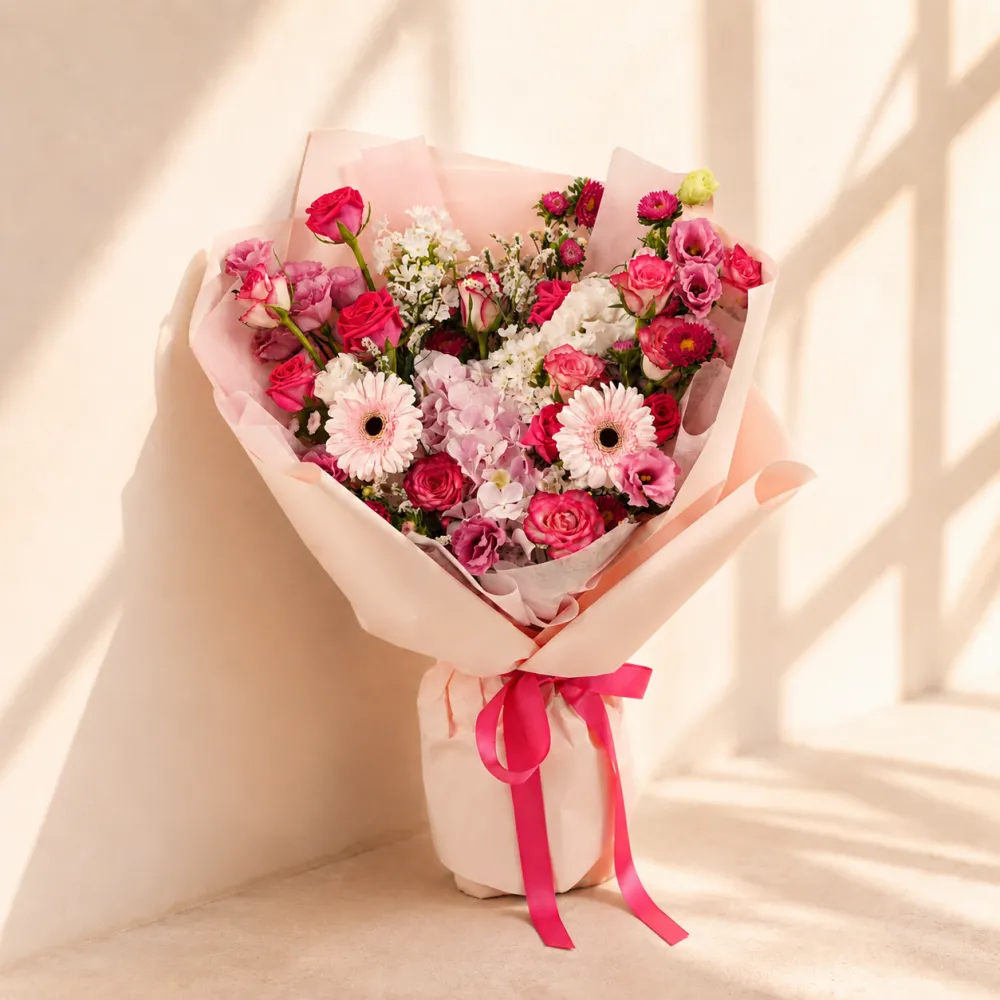
Deep reds and warm pinks, built dense and low rather than tall, so it reads as something held rather than displayed. It photographs better in a domestic room than in an office, which suits where it usually goes.
It is most often ordered for Valentine's Day, birthdays, and — a distinctly overseas pattern — for no occasion at all, on ordinary weekdays, from people nine or ten time zones away who have just woken up thinking about somebody.
Dense low arrangements trap moisture in the centre. On arrival, check that the inner blooms have airflow and remove any leaf sitting against a petal. Change the water rather than topping it up, recut every second day, and keep it off the top of a refrigerator or television, where rising heat will shorten it by days.
Expect five to seven days.
The song is not a happy one. Anyone who knows it knows that, and it does not stop them singing it.
That is worth remembering when you send this. It is not a cheerful bouquet, and it is not pretending to be. It is for the particular tenderness of loving someone from further away than you would like — which is not sad, exactly, but is also not nothing.
내 사랑 내 곁에 translates roughly as 'my love, beside me'. It is also the title of a very well known Korean ballad, so the phrase carries a familiar emotional weight for Korean recipients — a warmth defined by someone's absence rather than their presence.
It is one of our most requested pieces for Valentine's Day and birthdays, but a large share of orders come with no occasion attached at all — sent on ordinary weekdays by people living abroad. The name carries the sentiment on its own, which is part of why it is chosen.
Almost certainly, if they are Korean. The phrase is widely recognised. If you would like the card written in Korean, we will copy out your message by hand in Korean at no charge — just write it in whichever language you think in, and tell us which language it should arrive in.
Deep reds and warm pinks, built dense and low, tied by hand the morning it goes out. Delivered the same day across Korea with a handwritten card in English or Korean at no charge — ordered in USD from anywhere, and photographed at the door so you can see it arrive.
Published September 9, 2026 · by Arrive in Bloom · Flower Editor